
Rainfall Prediction (Time Series)
Project Information
- Category: Machine Learning / Time Series
- Type: Time Series Prediction
- Status: Completed
- GitHub: View GitHub →
Python Pandas Matplotlib, Seaborn Statsmodels Pmdarima (Auto-ARIMA) Scikit-learn
Rainfall and Extreme Events Prediction (Time Series)
This project uses advanced Data Science techniques to analyze the rainfall history of the State of São Paulo and predict precipitation volumes, assisting in anticipating critical events such as droughts or floods. The work includes the entire development cycle of a predictive model: data ingestion and cleaning (DAEE 1985-2021), exploratory analysis, temporal feature engineering, training of multiple architectures, hyperparameter optimization, and statistical interpretabilty analysis. The study compares the performance of classical linear models against approaches that account for seasonality, defining the safest strategy for regional hydrological planning.
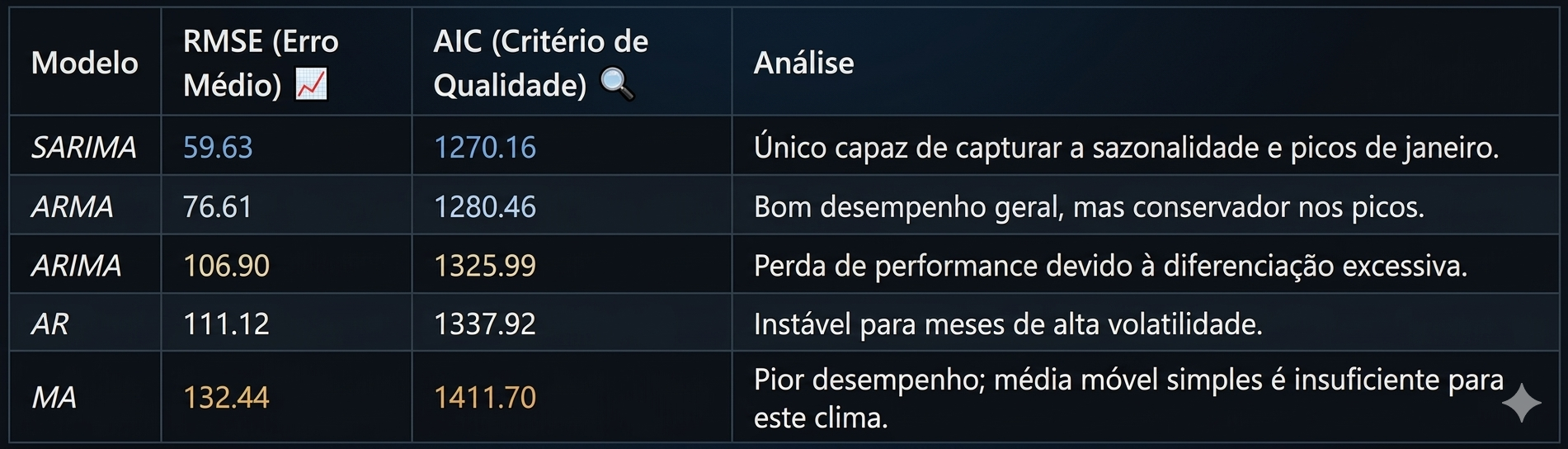
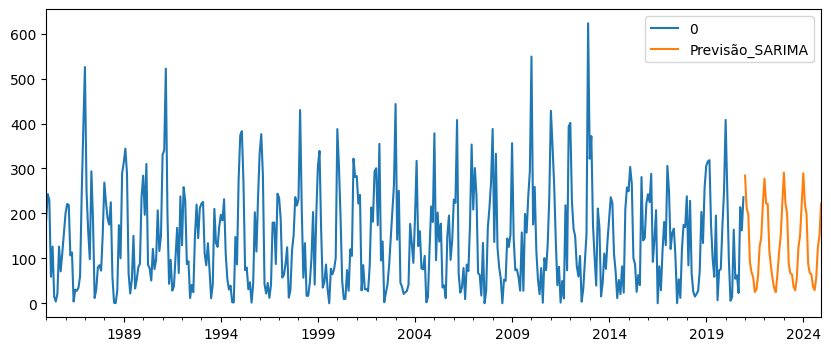
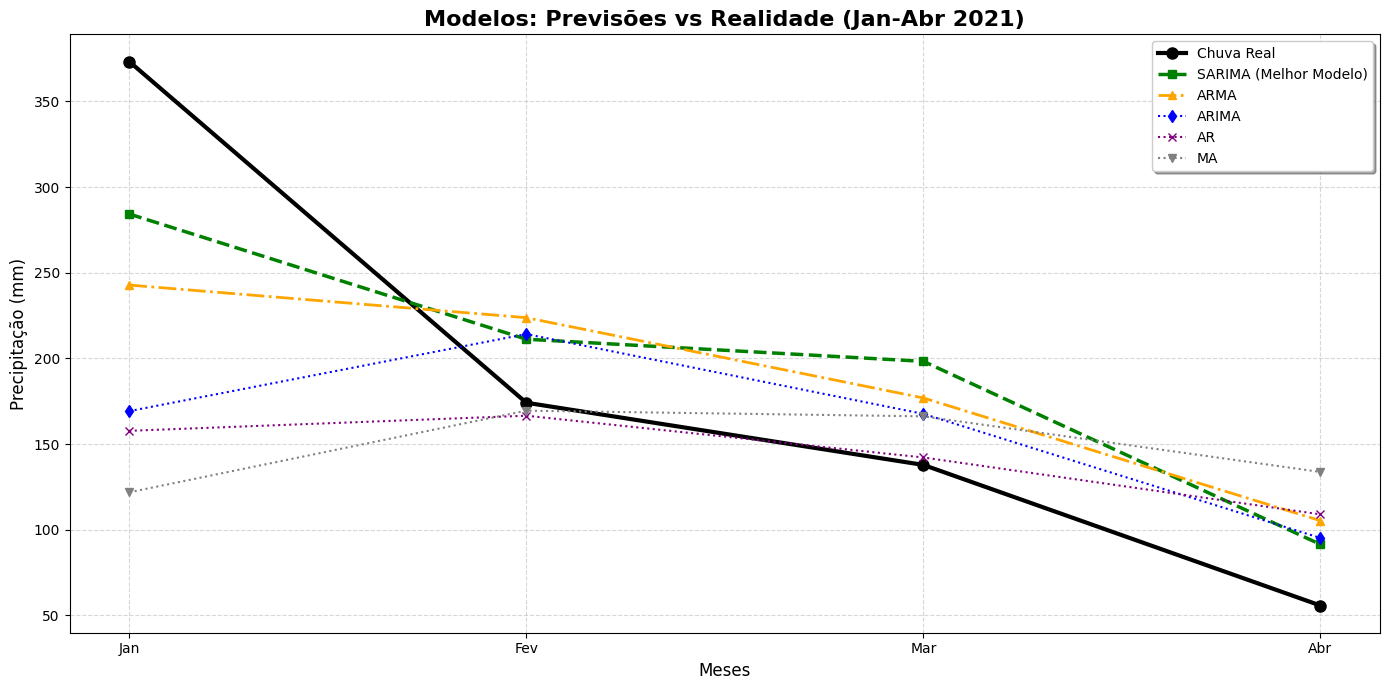
The SARIMA model proved to be superior across all evaluation metrics, achieving a RMSE of 59.63, representing a drastic error reduction compared to simple AR and MA models. The differentiator of this approach was its ability to capture the characteristic seasonality of the tropical climate, accurately forecasting the January rainfall peaks where conservative models failed. This assertiveness transforms historical data into a prevention tool, enabling evidence-based water resource management and reducing the risks associated with natural disasters.
Key Highlights
- Multi-criteria Predictive Modeling: Rigorous comparison between 5 time series models (AR, MA, ARMA, ARIMA, and SARIMA) to identify the best performance.
- Stationarity Tests: Application of the KPSS (Kwiatkowski-Phillips-Schmidt-Shin) test to validate the series structure and ensure proper trend handling.
- Optimization via AIC: Use of the Akaike Information Criterion (AIC) to select the model with the best balance between complexity and predictive power.
- Seasonality Capture: Implementation of seasonal components that accurately modeled annual rainfall volatility and peaks.
- Error Analysis and Validation: Detailed comparative evaluation (RMSE and MAE), demonstrating the superiority of SARIMA in mitigating the underestimation of extreme events.